The Golden Crop and Layout Kit
Golden-ratio crops in whole pixels and in the frame's own orientation, the thirds lines, phi lines and spiral's eye measured against each other on your frame, and layout widths split so every pixel is used, with phi treated as one option on the menu rather than a rule of beauty
GoldenSpiral's Golden Ratio Grid draws phi lines and suggests a golden crop, in decimals. Until this edition it always suggested a landscape rectangle, so a 4000 x 6000 portrait came back as a 4000 x 2472 strip that keeps 41.2% of the picture, where the portrait golden crop, 3708 x 6000, keeps 92.7%; we fixed the tool while writing this kit. The other gaps are still yours to close: a real crop is whole pixels at a position, the rule of thirds, the phi lines and the golden spiral's eye put a subject in three different places, and three columns rounded one by one can miss their container by a pixel. This kit works all of that on your own numbers. It crops 6000 x 4000 to 6000 x 3708 and says where the 292 trimmed pixels come from, locates the spiral's eye at 0.7236 of each side (nearer the thirds line than the phi line: 342 px against 633 px on that crop), shows how far apart the guides are at the size people will see the picture, splits layout widths by largest remainder so a 1440 px three-band layout adds up to 1440 and not 1441, and writes every whole-number ratio with its error (8:5 is 1.11% below phi). It makes no claim that the golden ratio is the most beautiful proportion: it sets phi beside thirds, 3:2, 16:9 and A4's root 2, and its claims check card cites the published research on the Parthenon, the nautilus, sunflowers and preference experiments. Included: 7 steps, a crop worksheet, a layout split sheet, a two-crop log, a golden crop table, the claims check card, a quickstart, and a personalised sheet worked from the frame, length or Fibonacci term you enter in our calculators. All worked figures are examples.
Look inside
Two full pages from the pack, exactly as printed. Click either to read it at full size before you decide.
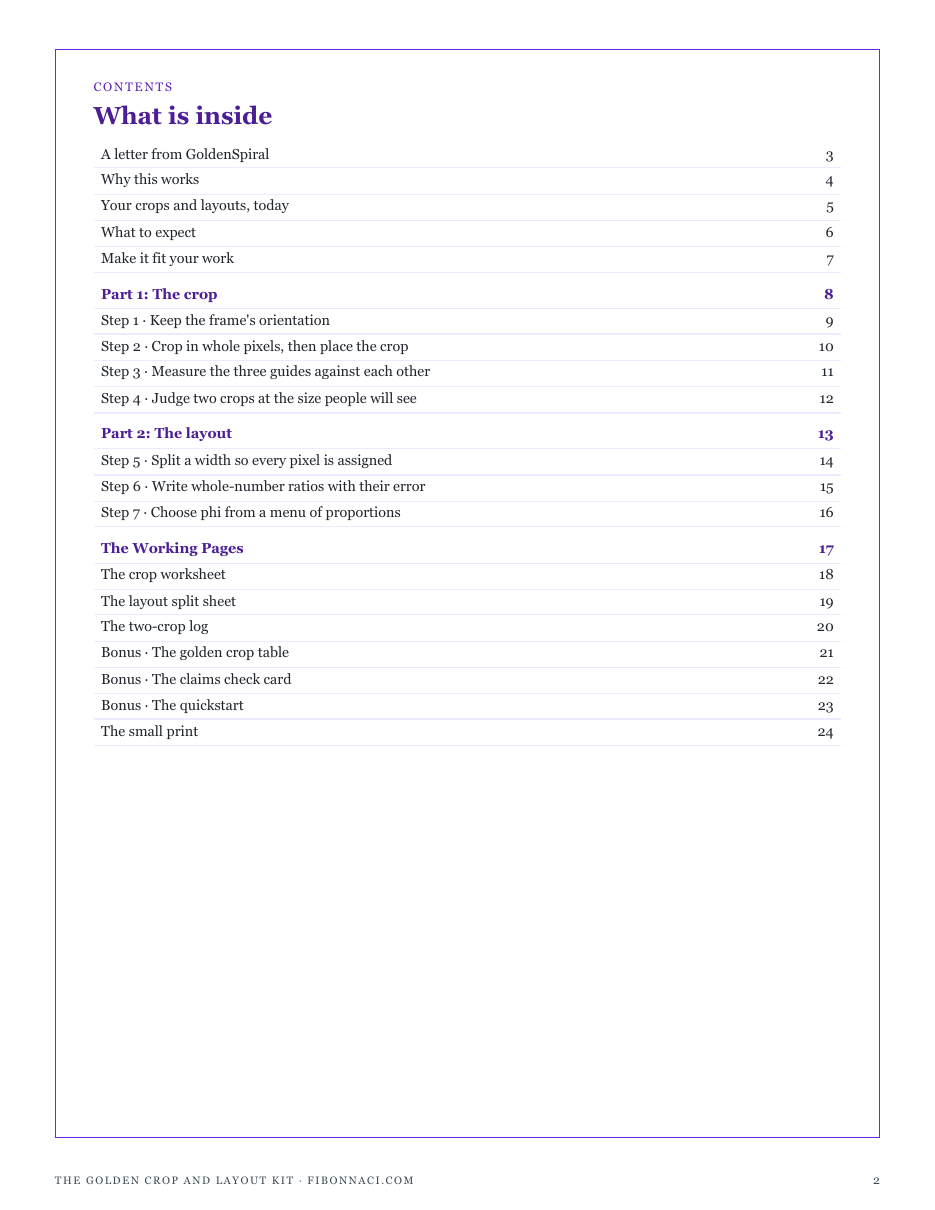
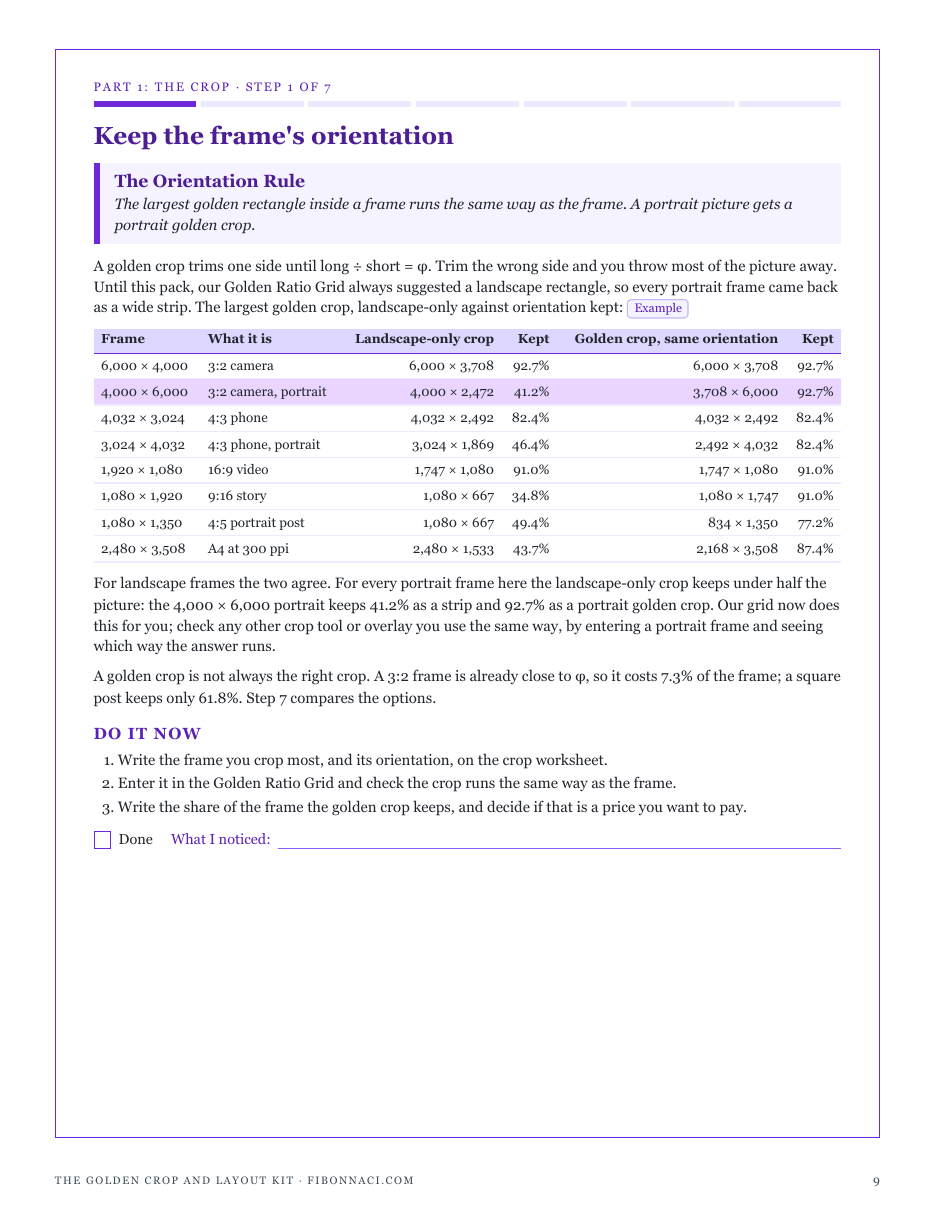
What is in it
- The Orientation Rule: the largest golden crop runs the same way as the frame, and what a landscape-only crop costs a portrait
- The Whole Pixel Rule: golden crops rounded once, their real ratio, and where the trim comes from
- The Three Guides Rule: thirds, phi lines and the golden spiral's eye measured against each other in pixels
- The Viewing Size Rule: how far apart the guides are at thumbnail, phone, desktop and print sizes, and the two-crop test
- The Every Pixel Rule: layout widths split by largest remainder so columns and gutters equal the container
- The Name the Error Rule: Fibonacci pairs and other whole-number ratios written with how far they sit from phi
- The Menu Rule: phi beside 1:1, 5:4, 4:3, root 2, 3:2, 16:9 and 2:1, for crops and for columns
- Three working pages: a crop worksheet, a layout split sheet and a two-crop log
- A golden crop table for common camera, phone, video, social and print frames, a claims check card with sources, and a quickstart
- A personalised sheet worked from the frame, length or Fibonacci term you enter in our calculators
- ✓ 24 printable pages
- ✓ 10 sections, worksheets and templates
- ✓ A second PDF worked out from the numbers you enter
- ✓ No account needed, just an email address
- ✓ Instant download; link valid 7 days
Price includes any taxes. Sold by GrabURL, who handle checkout and support. The charge appears on your statement as GrabURL.
The pack picks up where the free Golden Ratio Grid leaves off. The grid draws phi lines and suggests a golden crop in decimals; the pack keeps the crop in the frame's own orientation, rounds it to whole pixels and places it, measures the rule-of-thirds lines, the phi lines and the golden spiral's eye against each other on your frame, splits a layout width so the columns add up with the Golden Ratio Calculator, and writes every whole-number ratio with its error. It treats the golden ratio as one proportion on a menu, not a rule of beauty, and its claims check card cites the published sources.